
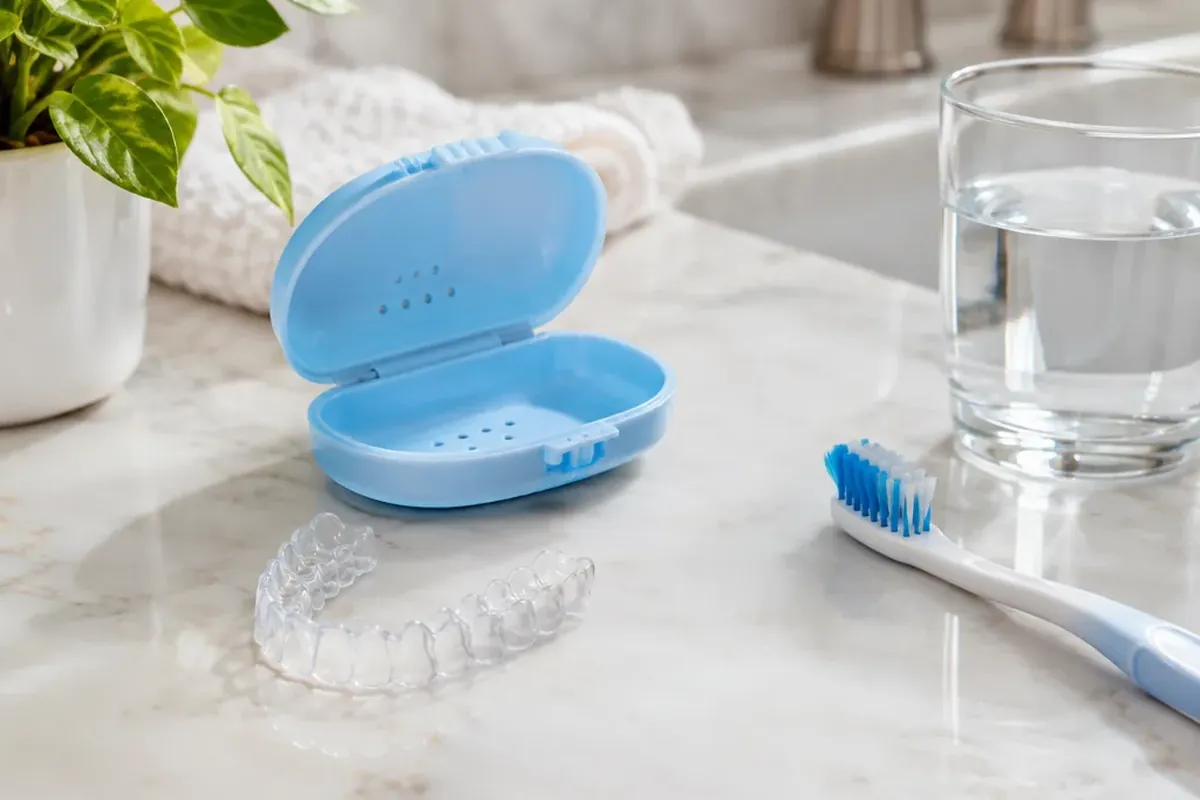
To clean a retainer, rinse it in lukewarm water every time you take it out, brush it once a day with a soft toothbrush and mild dish soap, and soak it about once a week in a retainer-cleaning tablet solution or diluted white vinegar. Never use hot water, toothpaste, or bleach, because they warp or scratch the plastic. The same routine works for clear plastic and Hawley retainers.
Daily Routine: How to Clean Retainers Without Causing Damage
Start the routine every time you take your retainer out, so saliva minerals cannot harden onto plaque.
- Rinse immediately: The moment you remove your appliance, hold it under a stream of lukewarm water for at least ten seconds. This quick step prevents saliva and plaque from drying onto the surface.
- Brush with mild soap: Clean the appliance daily using a dedicated soft-bristled toothbrush and mild dish soap. Never use toothpaste, as its abrasive particles scratch plastic surfaces.
- Keep brushes separate: Use a toothbrush reserved only for your retainer, not the one for your teeth, so no toothpaste abrasives get onto the plastic.
- Prep your teeth first: Clean your teeth before reinserting your appliance. Placing a clean retainer over unbrushed teeth traps plaque against your enamel overnight.
- Caring for permanent bonded retainers: If you have a permanent bonded wire behind your teeth, floss and brush between the wire and the teeth every day using floss threaders or interdental brushes.
- Store securely: Always store the retainer in its protective case when not worn. The American Association of Orthodontists rule is simple: "If it’s not in your face, it should be in your case."
Safe Soaking Methods: From White Vinegar to Retainer Cleaner Tablets
Soak your retainer once a week in a retainer-cleaning tablet or solution for 10 to 20 minutes to remove bacteria and debris. Cleaning tablets dissolve in warm (never hot) water. In one manufacturer’s lab testing, a common tablet killed 99 percent of typical odor-causing bacteria. Follow the soak time on the package, rinse thoroughly afterward, and take wire-containing Hawley retainers out promptly: one tablet maker sets a limit of 15 minutes for appliances with metal parts.
Common household options also provide safe cleaning alternatives:
- White vinegar soak: Soak your retainer in equal parts white vinegar and lukewarm water for 20 to 30 minutes to dissolve mineral deposits. One study showed that soaking clear plastic retainers in white vinegar eliminated more bacteria than brushing alone. Rinse well with fresh water afterward.
- Diluted hydrogen peroxide soak: Submerge your appliance in a 1:1 solution of 3% hydrogen peroxide and lukewarm water for 15 to 20 minutes to remove stains and bacteria.
Choosing the Best Retainer Cleaner for Your Routine
Each method has its own job, from daily washing to removing mineral buildup.
| Cleaning Method | Recommended Frequency | Primary Benefit | Key Precautions |
|---|---|---|---|
| Mild dish soap & soft brush | Daily | Removes plaque and surface debris | Rinse thoroughly; use a dedicated retainer brush |
| Retainer Cleaner Tablets | Once a week | Kills most odor-causing bacteria; cleans crevices | Never reuse solution; keep Hawley soaks short |
| 1:1 White vinegar bath | As needed for mineral buildup | Dissolves calcium and mineral deposits | Soak 20 to 30 minutes; do not use hot water |
| 1:1 Hydrogen peroxide bath | As needed for stains | Removes stains and bacteria | Limit soak time to 15 to 20 minutes |
| Ultrasonic retainer cleaner | As needed | Thorough at-home biofilm removal without abrasion | Operate on short 3 to 5-minute cycles |
Advanced Biofilm Removal: The Best Ultrasonic Retainer Cleaner Setup
Ultrasonic cleaners typically operate at 40 to 42 kHz and finish a cycle in 3 to 5 minutes. Paired with a cleaning tablet or mild dish soap, they give the most thorough biofilm removal you can do at home.
In a clinical study, ultrasonic cleaning in a chlorhexidine mouthwash left the fewest germs on clear Essix retainers, even fewer than brushing with chlorhexidine gel. Ask your orthodontist before using chlorhexidine. A laboratory study also found that ultrasonic cleaning restored optical transmittance and surface integrity best after coffee staining, while mechanical brushing left linear abrasions.
Never reuse a dissolved cleaning tablet solution, as it will not clean as intended a second time.
What to Avoid: 7 Damaging Mistakes That Warp and Ruin Retainers
Heat, harsh chemicals, and abrasion are what ruin retainers. Avoid these mistakes:
- Hot or boiling water: Never use hot or boiling water. Even water that feels too hot on your skin is too hot for the retainer and can warp the plastic.
- Abrasive toothpaste: Do not use toothpaste with abrasives or whitening agents. These leave micro-scratches that trap bacteria and cause discoloration.
- Household bleach: Never use bleach or other harsh chemicals. They degrade retainer materials and can leave harmful residues that irritate the mouth.
- Alcohol-based mouthwashes: Avoid alcohol-based mouthwash for soaking. Alcohol can weaken retainer materials and cause discoloration.
- Appliances and machines: Do not put the retainer in the dishwasher, microwave, washing machine, or dryer. High heat will distort the shape permanently.
- Sharp scraping tools: Never scrape hardened buildup with a sharp tool or pick. Scratches give bacteria more surface area to cling to and can ruin the retainer.
- Napkins and tissues: Do not wrap your retainer in a napkin or tissue. This is the most common cause of accidental loss when it gets thrown away.
How to Deep Clean Retainers and Remove Stubborn Tartar Buildup
White, chalky buildup on a retainer is usually calcium deposits (tartar or calculus), which form when minerals from saliva harden onto plaque left on the surface. Brown discoloration is typically plaque that has hardened into tartar and absorbed pigments from coffee, tea, red wine, or tobacco. Brown staining can also come from material aging, as some polymers change color over time even with regular cleaning.
For a step-by-step deep clean, follow this protocol:
- Preliminary rinse: Rinse the retainer with lukewarm water.
- Soak: Soak the appliance in a retainer-cleaning tablet solution for 15 to 20 minutes, or in a 1:1 white vinegar and lukewarm water solution for 20 to 30 minutes to soften mineral deposits.
- Gentle brushing: Gently brush the retainer with a soft-bristled brush. Optional: A baking soda paste (half water, half baking soda) can be used sparingly (no more than once a month) as a mild abrasive to lift stains and neutralize odors.
- Final rinse: Rinse the retainer thoroughly with clean water.
For thick, rock-hard deposits that do not respond to a single soak, repeat the vinegar soak daily for 2 to 3 days to dissolve layers gradually. If home methods fail to shift heavy tartar, take the appliance to your dentist or orthodontist. They have professional scaling tools that safely remove calcified deposits without damaging the appliance.
Essential Retainer Case Hygiene and Travel Tips
A dirty case can transfer bacteria and odor right back onto a freshly cleaned retainer. The case requires the same hygiene as the appliance itself.
Wash the retainer case daily with lukewarm water and mild dish soap, and allow it to air-dry completely before closing it. Once a week, deep-clean the empty case by soaking it in diluted hydrogen peroxide (1:1 with water) for 15 to 20 minutes, or in a denture or retainer cleaning tablet solution for 10 to 20 minutes, then rinse and dry. Dark residue in a case is typically mold or bacterial biofilm that forms in a damp, poorly dried case; if it does not come off with soaking, replace the case.
When traveling, keep your appliance secure by following these precautions:
- Pack a travel kit: Carry a soft-bristled brush, mild soap or retainer cleaning tablets, and a sturdy, ventilated case with air holes to reduce moisture buildup and bacterial growth.
- Always use your carry-on: Never place your retainer in checked luggage to avoid temperature extremes and the risk of loss.
- Watch water quality: In areas with questionable tap water, rinse the retainer with bottled or filtered water only.
- Use travel-friendly cleaners: Retainer cleaning tablets are especially practical for travel, requiring only water and no measuring.
- Avoid heat exposure: Never leave the retainer in a hot car or in direct sunlight, as heat warps the plastic and permanently ruins the fit.
Retainer Longevity: Signs It Is Time for a Replacement
No retainer lasts forever. Clear plastic (Essix) retainers typically last 1 to 3 years with proper care, although one cohort study found a median of only 105 days before replacement, repair, or loss. Acrylic-and-wire Hawley retainers last considerably longer, with a median survival of 1,529 days (about 4.2 years) in the same cohort, and with good care they can reach 10 to 25 years.
Replace your retainer if you notice:
- Cracks, fractures, holes, or thin spots.
- Warps or loose fit where the appliance no longer fits snugly.
- Persistent odor that cleaning cannot remove, which may indicate microscopic cracks harboring bacteria.
Do not force a retainer that no longer seats completely; forcing can damage your teeth or the appliance. If a retainer suddenly feels very tight, your teeth may have moved. Continued wear may push them back, but have the fit checked by your orthodontist.
Frequently Asked Questions
Is Dawn dish soap good for cleaning retainers?
Yes. A mild dish soap such as Dawn is fine. The American Association of Orthodontists recommends brushing removable retainers daily with a dedicated soft toothbrush and dish soap. Rinse the retainer thoroughly afterward so no soap residue stays on it.
What’s the white stuff on my retainer?
White spots are usually calcium and phosphate deposits from saliva that harden onto plaque left on the surface, forming tartar (calculus). White spots after cleaning can also be dried mineral residue from hard tap water, where calcium and magnesium remain after water evaporates.
What is the brown stuff on my retainer?
Brown discoloration is typically plaque and tartar that have absorbed pigments from coffee, tea, red wine, or tobacco. Brown staining can also result from material aging in older polymers. Rough or crusted spots suggest hardened deposits. Dark, fuzzy patches with a musty smell may be mold; in that case, replace the retainer.
How do I remove tartar buildup from my retainer?
Soak the retainer in equal parts white vinegar and lukewarm water for 20 to 30 minutes to soften tartar, then gently brush with a soft toothbrush. For thick deposits that do not respond to one soak, repeat the vinegar soak daily for 2 to 3 days. If home methods fail, visit your dentist or orthodontist for professional scaling.
Is it okay to stop wearing retainers after 10 years?
No. Even after 10 years, teeth can still move due to natural aging, jawbone structure changes, and lifelong soft-tissue pressures. Stopping retainer wear creates an ongoing risk of shifting. The American Association of Orthodontists states that most patients need some form of retention for life, which means nightly wear on a schedule set by your orthodontist rather than all-day wear.